Friday, May 23, 2025

DOWN LONDON STREET TO LIMEHOUSE

 
The United Reformed Church carries a date of 1800. Robust Tuscan columns and plasters form giant orders along the front. Not the most wonderful proportions but it has a powerful presence, especially as I enter the street from Jacob's Alley.


Then there's a quirky three story building dated 1870. Pale yellow brick with red accents. Further along we have the Nat West Bank. Remarkable for its Corinthian pilasters, each capital given a different treatment. Quite an orgy of creative invention. Rather rudely treated by the signage but it survives.


This is one of my choices for daily exercise. The War Memorial Park is just around the corner. Also it is a popular venue for all kinds of events. This morning they were setting up a circus tent. Last weekend it was vintage cars.

I have only just started to notice the wedge shaped stone slabs set into the perimeter pathway, with short poems inscribed. So far I have spotted two. Is it possible that they are pointers to the primary compass directions. Pure speculation on my part.

Basingstoke is full of these enigmatic markers, statues, plaques, historical quirks. I love it.


It was a cold day, by my standards at least, but I headed into London to meet up with my old pal Rufus. Been a while. We had a quick look inside St Anne's Limehouse which he showed me round before when I was making a Revit model of this splendid Hawksmoor church.

The stained glass of the main East window has been refurbished and is really glowing now. The deep blues especially really pop out. I have known this area off and on for almost 50 years through various friends and relatives living there, so it was nice to take a stroll past Limehouse Basin on the way to the church. Such depth of history to enjoy.


From the church we strolled down to Narrow Street for fish and chips plus a pint of draught hopsy beer. Important to fit that in at least once in any trip to the UK. The Grapes is a wonderful old pub, partly owned by Ian McKellen of Gandalf fame. It hasn't been spoiled by over diligent restoration work. Truly a gem.

Almost next door is Dunbar Wharf which also maintains its sense of age without drifting into disrepair. Rufus has ambitions to research and survey the property. Who knows, could be another collaboration. It would be a suitable challenge for the BIM pencil.


Wednesday, May 14, 2025

PATRIOTIC FISHING


The point is not to replicate a work by Escher but to reinterpret in a way that reflects the different medium. Lithography v BIM. The challenge is in the rendering. How to create a compelling image? An underwater feel with real depth.

I used planes of glass material and chose my viewpoint carefully. The addition of text is a nod towards the "information" aspect of BIM. I'm not claiming to have been fully successful in treating BIM as an artistic medium. 


Maybe if you take the larger sheet with multiple views as part of the work then it comes closer. Add in the fact that it was presented over time in blog posts, an allusion to the collaborative process. This unfolding over time could lay claim to be the use of BIM for artistic expression.

Of course it remains very derivative. Which great art can be. But this is hardly great. It's just nibbling around the edges. But hopefully it does point to the possibility. Just as photography is just a means of mechanical reproduction... And yet can be used by genuine artists to speak to our souls. BIM is just a project management tool/methodology. But we owe it to ourselves to use it to probe the human condition. Lest we become swallowed up in a world managerial tedium.


Imagine for a moment the investment in time and skill that went into any one of Escher's works. Then think about the effect of this disciplined effort of hand eye and brain over extended periods. Surely that transformed the man. He made the prints and they made him.

My version is from the 2013 Parametric Pumpkin competition.


Flying across the desert in an EK thirty one.

I saw Bob Dylan on the silver screen.

Landed on VE day just to find myself

a Brown Eyed Handsome Girl.


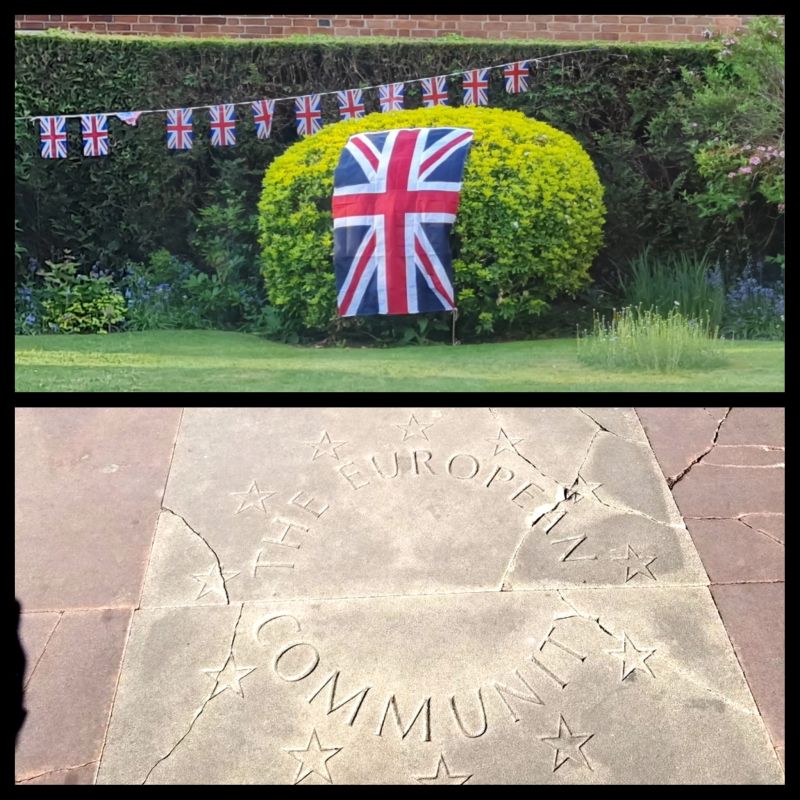
Apologies to Chuck Berry. The girl is my granddaughter and she has grown up a lot. The flags are in the garden of the block of retirement flats that will become my primary home next year. Arrived to a stack of mail and persecution for a TV license that I do not need. I gave up watching broadcast TV 30 years ago but apparently they can find me guilty in absentia.


 Waiting to see the brown eyed girl on Cross Street I noticed the blue coat boy for the first time. A bronze statue to commemorate a school that operated for almost 300 years but closed 150 years ago. That's the depth of history you routinely stumble across here.

 More recent attempts to mark history have a certain poignancy. An arrangement of paving slabs has sunk and cracked. One corner patched with asphalt. What does it celebrate? The Common Market and it's gradual evolution into EEC and later the EU. From trade agreement to bloated bureaucracy, it's a natural progression. Nothing more reliable in human affairs than mission creep.

 But I'm not trying to make a political point. Just noting how "the way we build" can hold up a mirror to our collective soul. Victory in Europe day led directly to a wish to bind nations together in trade. But those nations also had very deep histories, symbolised by the bluecoat boy and the Union Jack. Deep enough to crack those paving stones, hastily laid on top?

 New wine in old bottles perhaps.


Wednesday, May 7, 2025

CLOUD PUMPKIN LAND

I've been sifting through the working folders for my blog over the past 15 years. Quite a trio down memory lane. I extracted all the Revit files so they don't clog up my Onedrive. Instead I'm uploading them to ACC so that future upgrades will be easier.

It's quite reassuring to see so many files skip forward ten or more versions without incident. Once in the cloud I can organise the views and sheets to make all this work more accessible, firstly to me, and then... let's see.

The image includes some fascinating early dabbling in the Corinthian Order. This is around the time I started an ongoing dialogue with Paul Aubin which has since matured into a lasting friendship. I was trying to make the point that the classical orders allow for much more diversity than is often assumed. I also believe that a relatively crude abstraction can do the job for most situations.

The search for better generic furniture was a regular topic in the early years of my blog. And then there all those ventures into Point World. Those were heady days. What's another geometry challenge I can tackle? Oh, I know... Bavarian Baroque.

Sure do miss my buddy Bernhard. Gone too soon.


It's been great fun revisiting this little adventure. For my 2013 parametric pumpkin submission I went a bit over the top, creating Revit versions of three of Mauritz Escher's mindbending prints.

The dividing line between craftsmanship and art is very difficult to define. Printmaking can be pure craft, working to order. Escher was the consummate craftsman from wood engraving to lithography, but he used that skill to express his artistic vision. Much of his work explores the paradox of capturing our three dimensional world on a flat piece of paper.


My pumpkin pieces explored the possibility of BIM as an artistic medium. How to scale complex objects is another theme, one that also concerned Escher. Here the mixing of different viewpoints throws our mind into confusion.

"This is not a stair." Revit has an implied gravity, so a stair on its side will be a generic model. This is not a pipe. My scaleable pipe family imitates copper plumbing. I had an object like this in my twenties. Kept in my toolbag but used for something else.

Lots more jokes and trickery in there, but that's enough for tonight.


Still Life Street. Another tribute to M. C. Escher as part of my 2013 submission to Zach Kron's Parametric Pumpkin competition. This has also found it's way onto the Autodesk Cloud as part of my ongoing efforts to tidy up and future proof my BIM pencil work of the past 15 years or so.

Metamorphosis, Giantism, games within games. This was a tremendous learning experience for me and I like to think a source of inspiration for others. This phase of my work has passed away now. It reached a natural conclusion then gave way to Project Soane, Notre Dame and other subsequent ventures exploring history with BIM.


But that annual competition motivated to push technical boundaries and to look for the poetic potential of Revit. So often it is regarded as a rigid, clunky tool. So often we hear the call to rebrand BIM as information management. I understand why. But I choose to be a artist and to place my BIM work in the context of hundreds of years of creative expression by designers and builders.

Do we really think we will get to a better world by managing the hell out of life? Yes I embrace digital tools and greater productivity. But none of that will ever move my soul like a baroque church or a medieval town.