Friday, January 5, 2024

CHIANG MAI


What do I know about Buddhist Temples? In many ways they resemble a church: the nave, the aisles, the high pointed roof. The symbolism of bells and candles.

There is something fractal about the structural timber geometries, "fascinatingly fractal" you might say. Did the Greeks take a similar approach I wonder? When first I attempted the temple of Poseidon in Revit, I modelled a simple truss. Triangulation comes so naturally to the modern mind. I found it hard to to visualise a different spanning system.
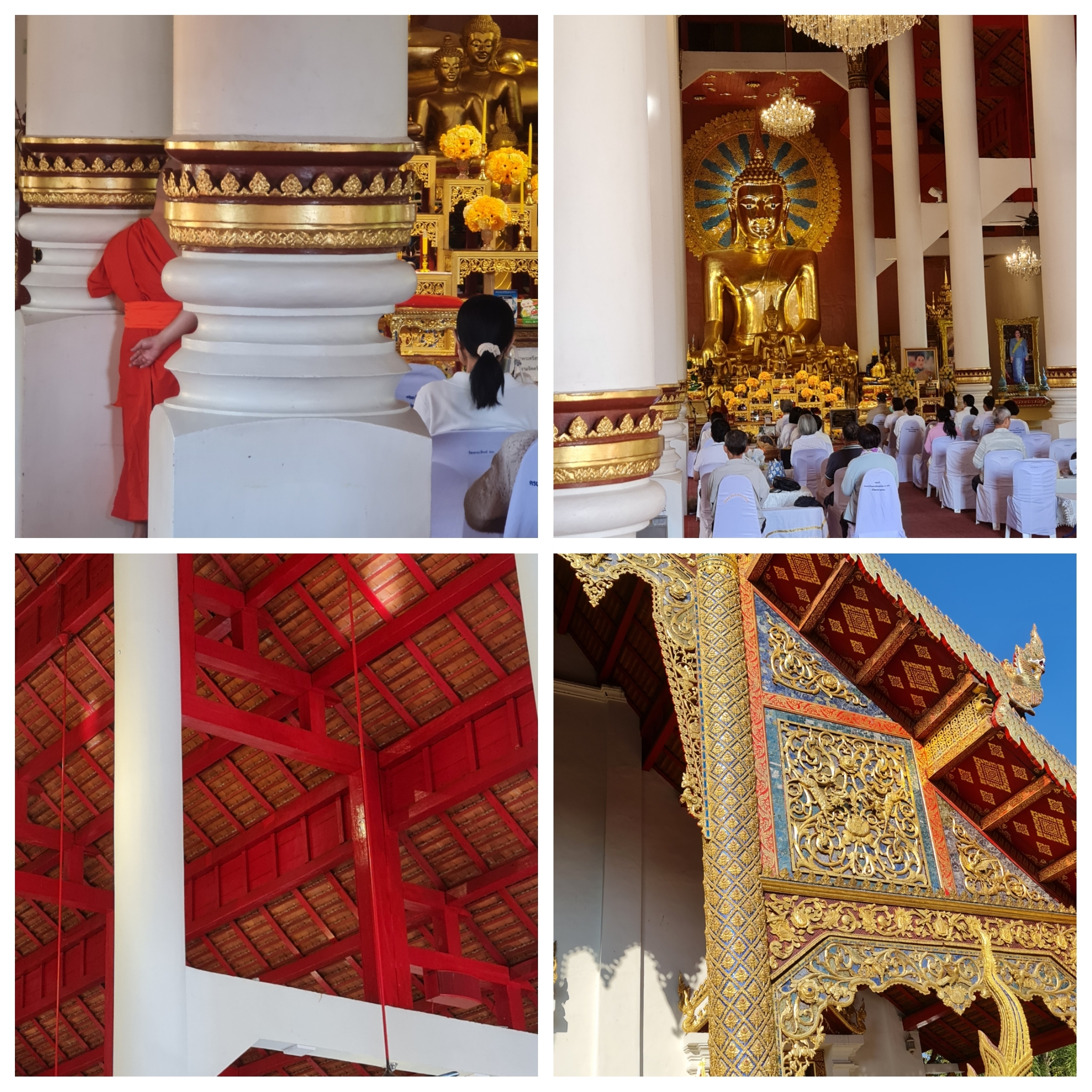


Talking of the ancient classicists, what about the columns here? They have base, shaft and capital. But there the resemblance ends and I am left with nothing to say. But how about that other fractal motif : stacked roofs, triangle within triangle?  Is this a natural out growth of the internal stacked beams? Or is it a representation of the hierarchical order of the cosmos?

Could be both of course.


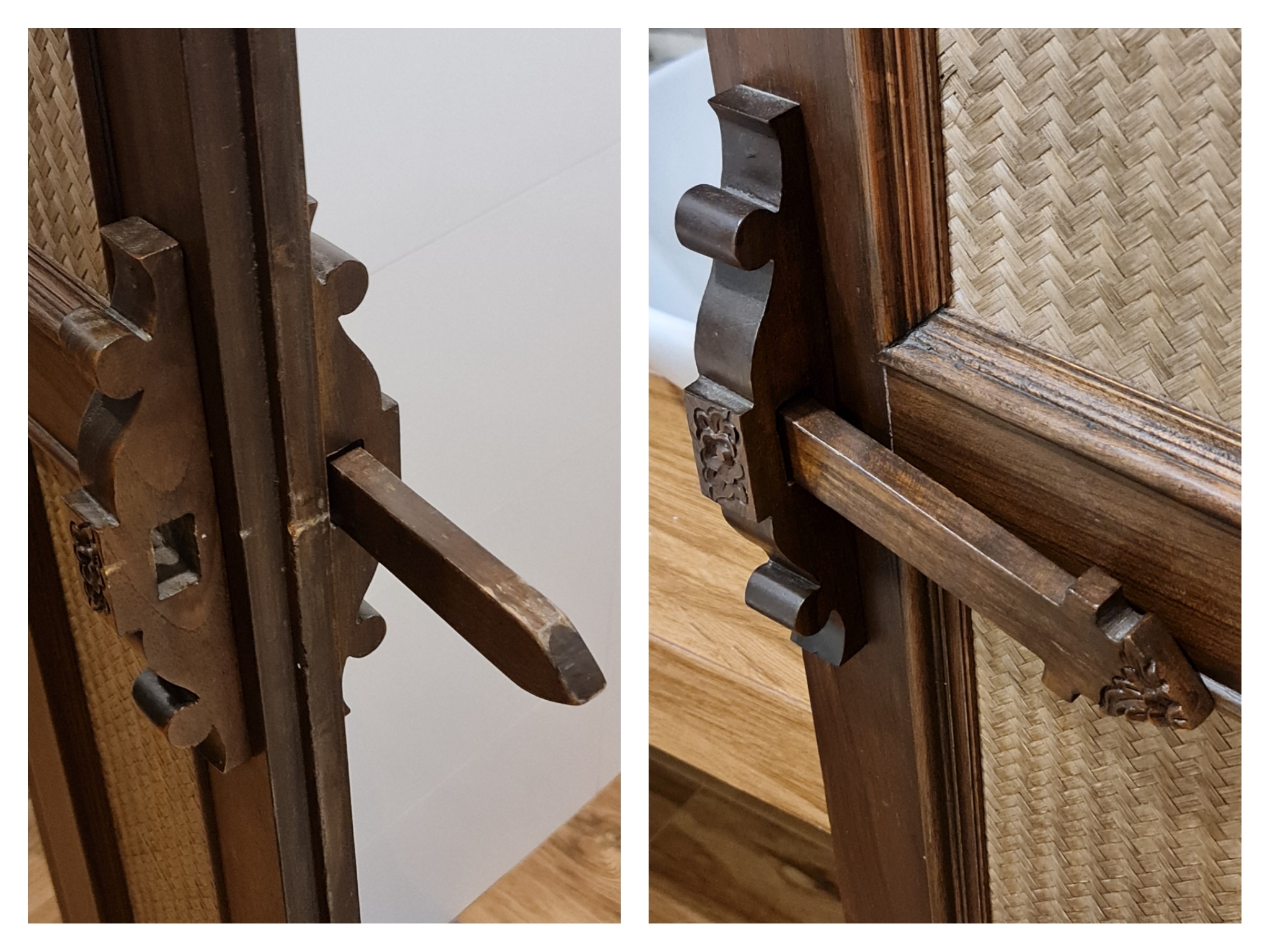
As architects we are so used to the idea that a single door is the default case, and double doors a minority solution for wider openings. But it’s not so long ago that hinge technology wasn’t really up to the task, or at least the economic trade-offs involved meant that double doors were standard, even for quite narrow openings.

This is the bathroom door of my hotel room in Chiang Mai. Not exactly the genuine article, the rest of the building is mostly “nondescript modern” but I think it is based on a traditional design.

Industrial mass production has brought us many things but it’s interesting that we crave the crude simplicity of earlier, hand-crafted solutions. It’s kind of cute to live with for a few days, but I think the novelty would quickly wear thin if this was my apartment.


This village street-market was a joy to visit. A reminder of people living much more traditional lives, just a short drive outside the city.

To a large extent, the materials are modern, but the approach to building is not. Do what you can with whatever comes to hand. Drawing it all out in advance makes no sense in this context, still less a digital model.


I have my doubts about the use of portland cement of course, and viewed up close it’s far from pretty. But still there is a picturesque charm to the place overall. It’s good to know that the world has not been completely homogenised by this “crazy little thing called progress”

Thanks you Chiang Mai for providing such a rich context this latest gathering of my far-flung family. A fitting end to 2023.


Marsa Al Seef was a great project to be involved in. Just revisiting the Revit models as I load them into the cloud for archiving. Such a lot of cross-linking with more than 50 separate buildings.

It's a shame we didn't have cloud collaboration up and running in those days. Would have been great for the design team to have accessed the federated model through the browser. Just another reminder that major technology shifts happen over decades as the pieces of the puzzle slowly come together.

The photographs were taken a few years ago when I was down in the area early one morning. It's a different place in the evenings with lots of people and interesting lighting. Of course, to some people, it's all "fake", but to me that's a very simplistic judgement.


The point is, does it work? Does it capture the spirit of an old souq and merchants houses down the side of Dubai Creek. Does it attract visitors and buzz with life? Does it respect the traditions of Gulf Architecture, the proportions, textures, balance between regular and irregular.

In my view the design team did a great job, the client showed vision and I'm quite proud of the Revit families I developed also. Lots of different permutations to mix and match. It was an interesting challenge and I learnt a lot, both what to do and what not to do.

Memories to cherish as we tick off another year.


Friday, December 29, 2023

DIGITALLY NOMADIC DREAMS

 I've spent at least 50 years looking at buildings and asking "Why?" Maybe 60 if you include my earliest dabblings in drawing house plans and enjoying the dark mystery of neglected Victorian hulks around me as a teenager in Barnsley.

It's a kind of reverse engineering I suppose. And here I am on an island paradise off the coast of Thailand, enjoying precious time with my family, but inevitably ruminating on what makes the buildings tick.

Steel frame makes sense when you have to ship everything across from the mainland. But it's interesting that they have emphasised grey cement colours... Thin cladding sheets and some acoustic issues. The styling is crisp and minimalist, but tempered by judicious use of wood. Don't compete with nature. Understated buildings bowing to the unspoilt beauty of site.


Until you get to the public areas of course. Here are flowing curves and a homage to indigenous roofing. Infinity edges give a sharp transition to a beach with rocky outcrops.

The detailing isn't exactly crude, but it's not super slick either. I'm guessing that wasn't a deliberate choice, more the nature of the situation. But I like it. Seems appropriate somehow. Perhaps buildings are like food. Super-refined may tittilate the taste buds, but it's not conducive to health in the long term.


Clockwise from top left. Precise detailing of balustrades in public areas. Looser fit with more traditional materials for the rooms. (I would assume that components are produced in quantity with limited types rather than made to measure for each instance.) Finally, a genuine design problem. Seems to be wood cladding used in external planters. May be some kind of synthetic wood but it is still vulnerable to decay in these conditions.

Easy to be wise in hindsight of course, and not very hard to fix. It's been a great few days here and I don't want to sound critical of the design team, or the developers and operators of this magical place. Perfection is not possible, perhaps not desirable. Certainly, pushing to hard in search of it can be disastrous.

I haven't managed to find this product online yet. "Composite Wood" probably, but the profile is more complex than anything I've seen so far. If you are thinking of using something like it, I would say go ahead, but probably don't use it too clad planters, or anywhere low down where it might be exposed to daily sprinklers.

At first sight I gave the stair handrails a bit of a frown, but on reflection it's a perfectly rational approach for an island resort. Ease of installation on site trumps carefully crafted junctions at least for the higher volume, repetitive items.


 The other end of the Thai experience spectrum. This is Chiang Mai: inland & north... a heritage hotel this time. Echoes of the shophouse typology that I have come to know and love in Singapore and Penang. But lacking the five-foot ways here.

Lightweight, open construction with internal courtyards to maximise air movement. I love the black and white theme plus the exaggerated height of the glazed doors. Style meets function in that effortless way that builders used to dash off, with or without an architect, or am I romanticising too much?


Either way, this is a delightful building from the colonial era, repurposed to create a boutique hotel of real character. And it's being run really well. Attention to detail in operations to match attention to detail in design. Lots of complementary vouchers to make you feel welcome. Foot massage available on the loungers by the pool.

The flow of space through the ground floor spaces of these old buildings is just magical. You're never quite sure if you are indoors or outdoors, and it doesn't really matter.


It's a hard life... 🤣🤣🤣 Digital nomad office (Chiang Mai Branch)

I'm just squeezing a few timesheet hours in while the younger generation go off doing more energetic stuff like playing with elephants.

It would have been great to benefit from this lifestyle while I was younger I suppose. Acutely aware that it's a privilege of the few however, and I am glad to have done my time on the tools in my twenties, in the classroom in my thirties, and on the drawing board either side of 40.

All the same it's great to catch a bit of "laptop luxury lifestyle" in my 70s. (aka LaLuLi) This one is dedicated to all those working with hands and muscles around the world to make my current life possible.

Quick shout out to the Microsoft Surface and hotel WiFi


Monday, December 25, 2023

PARADISE ISLAND, THEN AND NOW


Two concepts from 1995. Believe it or not, they are both based on fairly crude 3d geometry using Autocad. Probably Autocad 11. Certainly a DOS version.

I don't remember the exact process, but one was an attempt to pass through a digital pipeline. We had a "rendering" package, called AutoVision, but perhaps that came later. This appears to be a flat, shaded view. Also I had some kind of an image processing package, not as advanced as photoshop, but it's what I had. The name escapes.

The other method was to just set up the basic perspective and then sketch over that by hand. This results in a much nicer image, certainly more appropriate to the type of project. Two concepts from 1995. Believe it or not, they are both based on fairly crude 3d geometry using Autocad. Probably Autocad 11. Certainly a DOS version.

I don't remember the exact process, but one was an attempt to pass through a digital pipeline. We had a "rendering" package, called AutoVision, but perhaps that came later. This appears to be a flat, shaded view. Also I had some kind of an image processing package, not as advanced as photoshop, but it's what I had. The name escapes.

The other method was to just set up the basic perspective and then sketch over that by hand. This results in a much nicer image, certainly more appropriate to the type of project.


Last night I had dinner again with Karam Baki. It's always rewarding to have an online contact turn into a valued friendship. It so happens that I am older than his father, and our approaches to BIM are substantially different. However there are huge areas of overlap and most importantly we enjoy each other's company.

The venue was my local Syrian restaurant, Dyar Al Sham in International City: excellent food, great service and superb atmosphere. As we were leaving I spotted an enlarged image of a Roman theatre. One of the waiters confirmed that this was Bosra.

If only I was still young and adventurous, I would love to visit this place. But this morning it struck me that the images of Bosra, and Karam's article about his Dynamo exploits, (helping to solve the geometric challenges of Dubai's futuristic architecture) together symbolise the enormous scope and spread of BIM.

We share a passion despite differences of age, culture and skill-set. This passion allows us to dig deep into the meaning, construction and performance of buildings, ancient and modern. What a privilege to share this age of wonder and despair.


1997. This was probably the peak of my architectural career in Zimbabwe. Whatever you may think about the design, and I have my own reservations, it was by far the biggest project I handled as lead designer.

I was also responsible for maybe two thirds of the drawing set, and I carried it right through to completion on site. The visuals I produced look pretty flaky by today's standards, but at the time I was super proud.

It was a period where we installed our first office network. Coaxial cable and lots of drilling through walls. Sadly it was also a time when the Zim dollar began its precipitous slide. The company responsible for the external skin of flush glazing held on to a cash advance for too long and went bankrupt.

But I have fond memories of the way we all worked together. There was no backstabbing. We owned up to our mistakes and delivered the project on time and budget for the client. Soon after completion the work started to dry up. Inflation soared. I travelled to Malawi, Botswana and Mozambique in search of work. Things got pretty tough.

But for a brief period it felt like everything was working out, and my computer skills were an integral part of that optimism.


In 1998 I was dabbling with Archicad (top left). It was clear to me that the single-model approach was the future, but at the time the software wasn’t quite there yet. You had plans and 3d, “live” in the model, but for Elevations and Sections of construction-drawings quality you had to flatten everything out. Most people reverted to Autocad at this stage.

I ended up going with the Sketchup /Autocad combo for a while. Far from ideal, but it bridged a gap. My office tower was moving into fit-out stage. People were building gated communities as the currency continued to slide. I was effectively a single parent to three teenagers and just hoping this was a temporary blip and the country would sort itself out.

So my digital journey meandered through wordprocessing and desk top publishing as an educator, then I returned to architecture as CAD was taking off. Many a happy weekend getting the screwdrivers out to upgrade my desktop box. All this built on top of early experiences of print layout by hand and a lifelong love of drawing and painting.

And so I stood on the brink of BIM, just as Zimbabwe was going to the dogs. Something had to give.


Memories of a previous visit to Singapore, at the height of my enthusiasm for conferences. I was staying with my son before and after the event, but opted for a couple of nights at the Marina Bay Sands during the event. Breakfast with my feet over the infinity pool was epic.

I always thought that the best part of any conference was hanging with friends, old and new. Zach Kron is a unique figure in the Revit world. His Buildz blog inspired so many people to push the boundaries of conceptual massing, then he and Matt Jezyk became the dynamic duo of Dynamo.

I crashed the party via Zach’s Parametric Pumpkin competition, which became something of an obsession for me, four years in a row. Seems so long ago.


And now I’m back in Singapore for a family Christmas. My granddaughter is a joy to behold and my grandsons cracked me up with signature socks. Life is good 😍

I’ve worked on quite a few luxury resort projects over the years. Makes a change to actually stay in one. Short boat ride from Phuket to this little piece of paradise. With family as wide spread as ours, Xmas tends to be in a different place every year. This promises to be quite a special one.

I would say the room layout has prioritised drama over common sense in a couple of ways. I don’t mind the open hanging rail, but the room safe is far too low down for an old codger like me to use with comfort. And maybe they think anyone visiting their island wouldn’t possibly need a desk, but I’m on “part leave, part remote work”. Let’s hope I can manage out on the balcony.

A lot of talk about EVs but spare a thought for the humble buggy. Has anyone made a driverless version of these and coupled them up to an app yet? Not suitable for every climate and a bit slow compared to a taxi, but maybe they could be the vehicle that takes people from metro station to apartment, or does short haul movement in car-free city centres. (buggy bot?)

Probably just the tropical vibes going to my head.