Saturday, November 26, 2022

UPS AND DOWNS


Four churches in Mutare. Pics from 2003. Don't know why I didn't think of including these in my Revit churches series before, would make an interesting little group.

I hope I get to see Mutare again one day. Full of nostalgia for my previous trips, spread across a 23 year residence in Zimbabwe. Becoming a citizen, raising a family, watching things go wrong. Hyperinflation can only really be understood through first hand experience.

I clung onto that citizenship and the dream of retiring to sit under my mango tree. Sometimes you just have to let go of your dreams and accept the reality of what life has thrown your way.

I'm pretty sure that people are still worshiping in those churches, which is more than can be said for many in Europe. Vivid memories of driving past open air services under trees in Zimbabwe. Congregations dressed in white.


Three eaves and one verge. Two examples of extended timber rafters, and two variations on brick corbels.

The timber rafter extensions seem to have over - fussy profiles... until you realise it's just the same thing repeated two or three times. They are made up from smaller sections, bound together with metal straps. Each one has the same shaped end with slots for the straps to sit in.

The sections slide past each other like the telescopic legs of a tripod. I should do Revit versions of these, just to check out my assumptions.

Four years on and I'm still finding fresh insights and inspiration in the roofs of Volterra.


September 2018, and we were deep into Notre Dame. Starting to tell a story in pictures and words based on our voyage of discovery. That was a great little team. We all had slightly different motivations, but it didn't seem to matter.

Just take on a task and enjoy the conversation along the way. Lots of little geometry puzzles, and a tricky decision over how much "straightening up" to do.

For me, BIM is not restricted to the commercial realm, it's not all ROI and meeting deadlines. I draw to understand the world, to explore the nature of human culture as it has evolved over the centuries.

BIM as an artistic endeavour, comparable to music or painting. Not a dry and dusty business of protocols and compliance, but a joyful adventure. Fresh as the day I first held a pencil, or fired up a computer.


February 2019 was an unusual month for me. The only time I have spent a night in hospital. First ever "surgical procedure"... The indignity of wearing a catheter for several weeks.
i
Extra time with my grandsons was a bonus. I cherish every moment with those two. Jack decided to make paper place mats with images of food on a plate.

We visited a village called Upton Grey which lies on an old Roman road and decided to host a thunder storm.

This thin slab of glass that moves around with me has a timeline of my life "inside°, a living breathing scroll that extends my feeble, fallible memory. Forty years ago I carried a pocket notebook. Similar but different.

The arrow of time.


Snapshot from my cloud drive. These are screenshots taken while I was trying to understand the cap and pan roof system that I had seen in Volterra.

I was using my BIM pencil of course, "sketching in Revit" just to understand the geometry and how the tiles fit together, how they accommodate irregularities.

I'm sure I would have learned more by laying out real tiles on a real roof. Even more by spending a day in a tile factory. But piecing things together by trial and error with digital tools that I have been using daily for 15 years now is a pretty good way to learn.


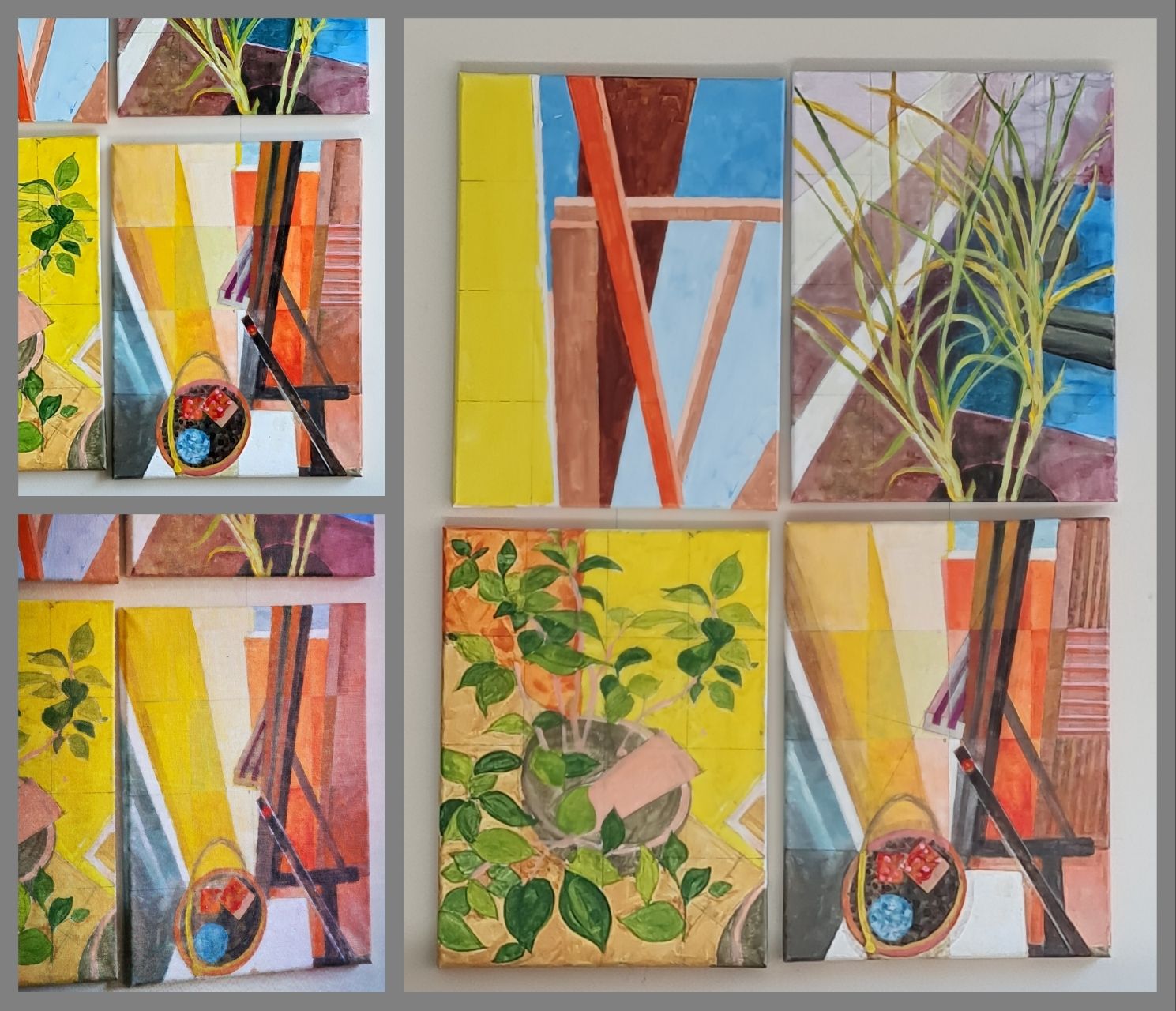
Second pass on the fourth panel this morning. I guess I am going in reverse order, this time around. Actually I just chose the one I was least happy with for further development.

Paint brush on canvas is a great way to start my weekend.


Sunday, November 6, 2022

BUILDING STONE COLD MEMORIES

I’m trying to post several times a week on Linked In.  These are mostly sets of images from my timeline, dating back anything up to 20 years (when I first acquired digital photography.)  The theme as always is the way buildings reflect the culture they spring from (time and place)  Ways of life can be very different around the world. 


There are a few little tricks to help convert snapshots like these into seamless textures using bitmap editing software like photoshop.

Offsets that bring the edges into the centre and back again. Clone brushes to soften out the hard edges along those crosshairs. It takes effort and judgment to do a decent job but I quite enjoy the challenge from time to time.

These images are from my visit to Porto in 2016. Three walls and a floor. Stone is such a wonderful material. Sadly neglected and treated too clinically in much modern work.

The old guys knew how to create surfaces that aged with majesty and grace, embracing the ravages of nature and entering into a symbiosis with the plant kingdom.


This is a follow up to a post by Silviu Stoian which reminded me of some Revit studies I did soon after getting back from Volterra 2018 (the Reality Capture workshop.)

"Cap and Pan" roof tile system which has an amazing ability to adapt to different roof widths and "not quite square" shapes.

You can vary the gap between pans, you can let the gap increase course by course, you can even use an upside down pan instead of a barrel cap.

All the tiles have a built-in taper, so that they fit together at the overlap. You can’t help but admire the deceptive simplicity.

The last image is my interpretation of a wood and brick flooring system, using the typical roman brick proportions so loved by Frank Lloyd Wright. A cross between a brick and a tile really.

You can see the under side of these floors if you look up when passing through some of the narrow alley ways that cut across between streets in Volterra.


Mutare Club, photographed in 2003. Capital of Manicaland Province, along the Eastern border with Mozambique. This was towards the end of my stay in Zimbabwe.

Hyperinflation was ramping up and the politics was becoming toxic. I still didn't know how I was going to get out of that frying pan but I was certainly starting to worry.

All the same I was deeply impressed by the history and technology of the buildings around me and building up a library of images with my new digital camera.

Is colonial architecture a source of shame? An opportunity to display your inner resentments? We seem to be tempted by these follies in recent years.

As a response to climate, an exercise in proportions, a balancing of solid and void, surface and line... I have always found this building rather charming.


A staircase by Le Corbusier in Boston, Massachusetts

‘Carpenter Center for the Visual Arts’

Winter of 2008/2009... Visiting my daughter. We drove up from New York to Boston one weekend. Also saw the Lion King on Broadway.


Western Uganda, 2009. Off the beaten track, heading towards gorilla country (the mountains that mark the border with D.R. Congo.) We didn't actually get that far. But we did pass through Kilembe, a semi-derelict copper mine town.

Perhaps many of the former workers stuck around and carved out a subsistence living on the steep slopes. The carving metaphor is apt. Must be hugely labour intensive. First of all digging out a shelf for the house, then hauling up water and everything else on a daily basis from the valley below.

Wikipedia suggests the mining activity has been resuscitated. So what's the better life?

Regular money and living in barracks-like company housing.
Backbreaking subsistence farming in direct contact with nature.
Chained to a home-office laptop with Netflix and deliveroo for company.

Who can say?


Two of these are undersides of roof assemblies. Tuscan roofs tend to be quite shallow. Is this partly because they often use the same basic support system as many floors? The third pic (with the arch) is a floor.

The common factor: square section timbers, spaced one brick-length apart, supporting rows of headers. There is enough free play in the system for it to follow a slow curve and accommodate odd angles. This approach also results in a fairly high thermal mass, "flattening the curve" across a 24 hour temperature cycle.

Those three pics were taken in Volterra in 2018. The fourth is from a bit further south: a slightly different tradition, where both cap and pan use the same barrel tile.

I love this eaves detail, where the last tile in each valley is projected slightly, delivering water into the gutter while leaving it relatively open for cleaning. Elegance and function combined.

Solutions like this emerge from generations of artisans learning from each other, trying things out, keeping what works. Cultural evolution working its magic at a subconscious level that self-conscious design professionals like me view with awe and envy. 🤔


Monday, October 31, 2022

THE WEEK THAT WAS

 Linked In posts for Early October 2022.  Playing guitar on my balcony, starting a painting project, looking back at my one and only visit to Portugal, and the “ancient past” of life in Zimbabwe.

There is a certain severity in the architecture of Porto. Partly the nature of the local stone, partly the maritime climate blowing up river from the Atlantic. But this is tempered by a somewhat idiomatic sense of the baroque.

What does that word mean? Like all words it means what thousands of people have coopted it to mean in a variety of contexts. Meanings morph continuously. It implies a bending of the rules of classicism, a bending of surfaces also, perhaps a bending of space-time 😜

Spiral columns, broken pediments, complex curves at every turn. Some snippets sifted from my visit in 2016.


I'm embarking on a little painting project. It's one of those things that just kind of happened. Can't remember why I started taking closeups on my balcony. Just a whim I guess.

The habit of combining photos in fours is just part of housekeeping my image gallery, but a couple of days later I realised it might be interesting to buy four cheap canvases at the local supermarket and mount a set of semi-abstract compositions close together on the wall.

Early days yet. Just roughed out the first two. Will get all four up to this stage and hang them together. Then I can keep looking at them. Bursts of activity as the spirit moves me. Layers of shading and texture oozing up from the subconscious mud.

Is anything ever finished? There will come a point when I'm more interested in starting something else.


Glazed wall tiles as an external finish are common in Porto. Sometimes they are flat and smooth, sometimes embossed. Blue and yellow are common with a white ground.

They form a marvellous contrast with the coarse grey stone. Splashes of colour and a surface that can be scrubbed down before the maritime life forms take too firm a hold.

Memories.


Just messing about on my balcony after a productive day of Revit work for my day job.

Music is such a great way to divert the brain from its endless chatter.  Slide guitar instrumental in open G.


These are photos I took in Bulawayo 20 years ago. At that stage I never imagined I would move to Dubai barely 18 months later.

Are these relics of a disgusting racist past? That would be one interpretation. Actually I have no way of judging the humanity of the architects involved though it's certain they were all white.

I do see a rich historical record: four different attempts to capture the mood of the time and to project the identity of a rapidly growing city with government buildings, offices, banks and hotels.

I was on a visit to the school of architecture there to teach a group of students about setting out buildings in a hands-on way.

Special memories for me. I wonder where they all are now?


I have many pictures of metal railings in Mauritius, dating back to the early days of my exposure to digital cameras. I will have to fish them out. Indeed a little series of posts on Port Louis would be a pleasant diversion methinks.

But these ones are from Porto. Much the same vocabulary. Some of these are castings, some hand forged by muscular blacksmiths. Of course I prefer the latter for pure aesthetics, but it's hard to resist the economics of mass production.

Call it the William Morris dilemma. I guess it brought us the modern movement with all its benefits and pitfalls. Don't get me wrong, glass balustrades are great. But you gotta love these old railings. Weather-beaten and rusty, they still tug at the heart strings.