Sunday, August 4, 2024

LOD LOLS


Two and a half weeks in, and I've just noticed that the wooden fence opposite my new flat is actually a hybrid construction. This suggests to me a sensible use of precast concrete. There are other possible solutions of course, but I don't have a problem with this one. None of the ugliness of concrete post and panel (what we used to call Durawall in Zimbabwe) but none of the rot issues of the traditional wooden fence it emulates.

On the left a bit of the old-style version, showing deterioration of the sill board and replacement of one of the gate posts. Already showing damp staining at the base. On the right the hybrid version with concrete posts and sill, all quite nicely detailed and economical in its use of the dreaded portland cement.

I'm not sure why it's so hard to design concrete buildings that weather attractively. People love stone, and it's not immediately obvious to me why concrete is at the opposite pole of the "material aesthetics" spectrum, especially from a distance when the natural grain and variation of stone is harder to spot.

But used like this, in small quantities mixed in with natural materials it seems fine. The paving slabs that lead up to my outside door are another example. Stained and slightly mossy, with the odd weed peeking through a joint and a few fallen leaves: perfectly fine.

But the same material used as wall panels... I don't think so. You can get away with the occasional sill or string course but as the main wall finish, exposed concrete conjours up prisons and bunkers in the mind. Or so it seems.


I've always thought of "the lounge" as more of a multi-function workspace. From my earliest days as a student of architectural 55 years ago. I wanted somewhere I could play music, paint pictures, build models, as well as to talk with friends, cook and eat. Living Room is a better term.

When did "lounge" become popular anyway? There was a time when "parlor" was the accepted label. That's one thing I love about old Architect's drawings, the ever evolving nomenclature. Soane always labeled his bedrooms "chamber" Is that an indication of changing patterns of use? Or is it the beginnings of our current mania for changing the "acceptable term", the inherent self-doubt of modernity?

Anyway I am gradually populating the biggest room in my future home. Currently a desk (displaying a Revit model of the flat of course) and space for three people to sit. All the furniture is quite easy to move around. Ideas will evolve with use. Also I probably want to replace the carpet with something that is more tolerant of messy activities.


I will probably have more to say about the Revit model. What is the appropriate level of detail? That perennial question. Depends on the purpose /context. I think of it more as a question to be constantly asked rather than a set of "universal standards" by which to judge if a model complies with the contract.

In this case it's just for me to visualise furniture in the space before finalising my order. Once it's recognisable and the right size, no point in putting in more work. I have plenty of other things I need to do this visit.


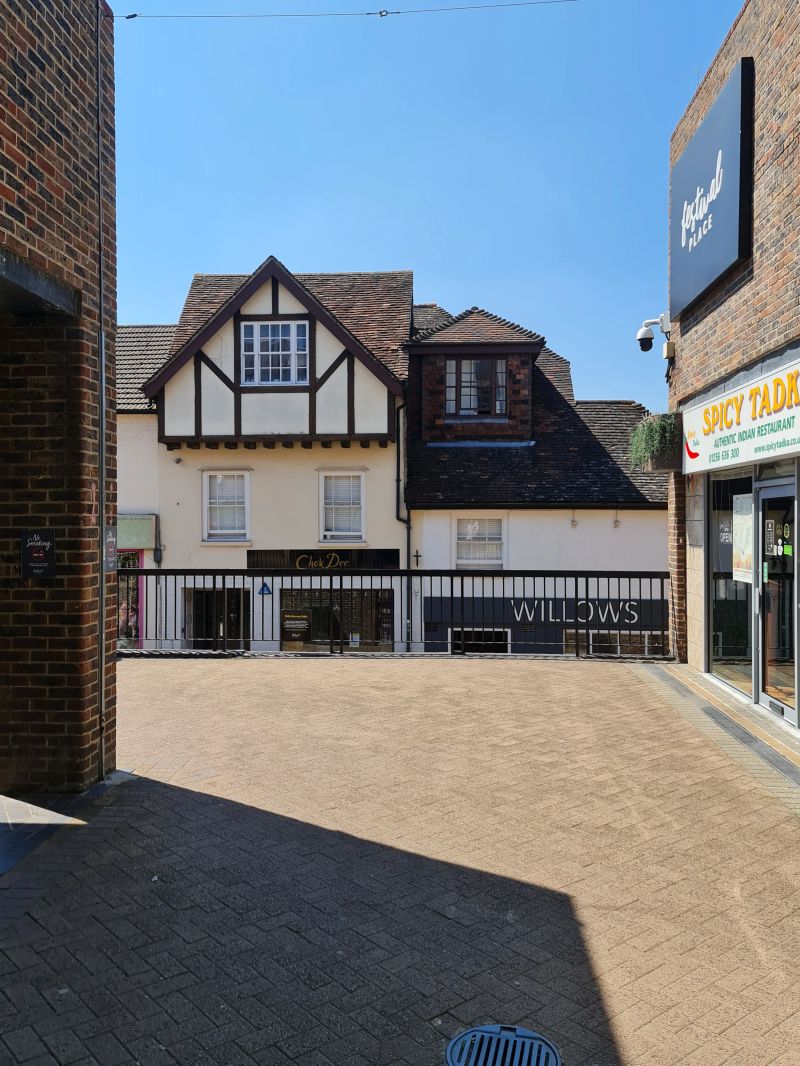
As an abstract combination of colours and shapes this has a lot going for it. Of course it wouldn't be the same without the bright sunshine, the clear blue sky and the shadow angle.

From that point of view I guess it was especially lucky to have been there at that particular moment in time and to have turned around to contemplate the view behind me.

The there is the juxtaposition of different cultural eras, styles, technologies. The gable and dormer look far too regular to be genuinely old. They could be Victorian or Edwardian inventions I suppose. Maybe they were rebuilt from photographs after a fire or collapse. Maybe I will learn more about the history of these buildings as time goes on.

Sometimes trees and people are crucial to bring the character of an urban location to life, but in this case it is their absence that makes the view so satisfying to my mind. There is a strange tension between the picturesque and the minimalist impulse.

This is quintessential Basingstoke. At almost every turn the old town and new town are spliced together. Neither of them exceptional examples of their type, but the way they are woven together helps a lot.

It's just a moment in time, but it will do.


More heresy about the dreaded LOD. I wanted to check the space between daybed and bookshelves. In particular, can I get a Step-stool in there and does it look like that would be useful for an old man with a dodgy back to find books on the bottom shelf. (something to sit on/lean on)

The family I made is missing one extrusion to match the actual IKEA product. But that can be added at any time, so I declared the family "fit-for-purpose" and moved on. Now that it's been ordered, delivered and assembled, I realise two more things.

Firstly it's useful as a bedside table. Secondly if I really wanted to venture up the LOD ladder, the legs have a slight slope, for stability obviously. But my virtual room is perfectly fine. Real life takes priority.

The bookshelves are a system with different sizes. It would have been fun to introduce arrays and make a single parametric family to cover all the options. But I decided that was overkill and made two fixed-geometry objects.


The fireplace is part of the flat, but I added a bit of detail just to trick my brain into imagining the space. The metal shelves should have baskets, but again, why go to the extra effort?

So I'm making judgement calls. What LOD fits the situation. And that's my point. LOD is a useful concept to remind us that we can start with very simple bounding boxes with generic labels. As a project progresses we can refine both geometry and data. It's a choice to be made, not a set of cast-in-stone rules that bog down the design process.

My opinion.


Friday, August 2, 2024

EXPLORING BSK


Let's do a bit of compare and contrast shall we. The two parallel worlds that I inhabit during this (final?) transition period of my life. Call it Dubai v Basingstoke. Or rootless growth v weighed down by history. Thing is, I Iove them both.

The two storey houses with an arts-and-crafts vibe are just down the road from me, snapped on a gentle evening stroll. A street of detached and semi-detached homes, each one different, well kept, nice cars. This is one side of England. the side that I never knew in the 30 years I lived here before. When I was a Yorkshire boy, first generation to go to university. I was intimidated by the confident affluence of the home counties. 


45 years later and I've had my adventures around the world, never rich but I did OK. So I don't feel intimidated by all this comfortable wealth. Just interested: in the materials, styles, construction. In the time they represent: before the disaster of WWII, the naive optimism of London overspill planning.

And as I spend more time here, the dusty dynamism of International City Dubai will be seen afresh, from a distance. 20 years at GAJ will seem like a dream perhaps. These shots flatter my other home a bit. Photographs are so selective, so seductive. But it's clear we are dealing with a very different place in almost every way

What do you think?


Ginnel, snicket. Sikka, alley. These narrow passages between properties have always fascinated me. Narrow enough that every slight deviation hides the destination, imparts a note of mystery.

This is not architecture in the grandiose sense. It's more a case of forgotten facades and accidental artistry. But deliberate design doesn't always lead to the best results. The beauty of old towns and villages often stems from a lack of central planning. They evolve.

That's an organic metaphor and I don't have a theory of natural selection to match Darwin's. But we do have an aesthetic sense and it helps us to survive. I suspect that the modern malaise is partly down to over-planned environment. Our genes favour forests, grasslands, rocky hilltops. We also thrive in urban settings, but maybe they need to be shaped by happy accident and subconscious choice. 


Is this just the romantic delusion of advancing years? I hope not. Ginnel, snicket. Sikka, alley. These narrow passages between properties have always fascinated me. Narrow enough that every slight deviation hides the destination, imparts a note of mystery.

This is not architecture in the grandiose sense. It's more a case of forgotten facades and accidental artistry. But deliberate design doesn't always lead to the best results. The beauty of old towns and villages often stems from a lack of central planning. They evolve.

That's an organic metaphor and I don't have a theory of natural selection to match Darwin's. But we do have an aesthetic sense and it helps us to survive. I suspect that the modern malaise is partly down to over-planned environment. Our genes favour forests, grasslands, rocky hilltops. We also thrive in urban settings, but maybe they need to be shaped by happy accident and subconscious choice.

Is this just the romantic delusion of advancing years? I hope not.


Something about the proportions of these two chimneys really does something for me. They are directly in view when I sit outside my flat. Funny thing to rave about perhaps, but looking closer I see a bell-mouth in the plaster overhanging the lead apron flashing.

I always like red clay ridge tiles over a purple - grey slate roof. Maybe it's a red white and blue thing, my subconscious patriotism showing through. I left this country 43 years ago, thoroughly sceptical of queen and country. So much has changed. I wonder if Britain has become more sceptical about itself than I am now about this amazing place.

Thing is, I'm going to enjoy living with this bit of old-school roofing as the view that greets me every morning. It's a reminder of the layers of cultural history on display at every turn: a gradually unfolding tapestry. Humans are deeply flawed of course but it's not for me to stand in judgement of my grandparents.

I have the privilege of being able to move between cultures for a year or two yet. Still primarily based in Dubai, but preparing a future for the "prodigal Grampa" to return to.

Enjoy the chimneys. I certainly will.


Wednesday, July 31, 2024

GOING TO CHURCH


Two examples of brickwork from my morning walk. What is it about modernity that strips the magic from everything? Is it just the drive to do more with less (aka efficiency)? Have we somehow lost our sense that every little detail of our lives is sacred? Is it the iron grip of economics upon our souls?

Bucket handle pointing, at least that's what we used to call it. There were numerous advantages touted, but I don't remember beauty being on that list.

Maybe you don't see the problem here. Perhaps it's just an old man indulging in nostalgia. The love of old things just because they remind me of my lost youth. Perhaps Flemish Bond is just more intriguing to our brain's pattern-recognition system. Stretcher bond is such a dull name after all.

On the other hand it's such a thrill to see this variety of texture, this depth of meaning all around. A hundred years and more of human history all around and living in harmony.

You've got to hand it to those soft orange bricks though. They warm my heart. Not to mention the thin delicacy of lime-mortar joints, speaking of days when bricklayers were loyal to their craft for fifty years or more.


Morning walk no 3 took me past a rather splendid Gothic Revival church. You can imagine Basingstoke expanding to the south as the industrial revolution kicks in, and the parish church of St Michael no longer being adequate to serve the whole community.

Temple Moore was an interesting architect, closely connected to the Scott dynasty. Pupil of "Middle Scott" who was the least prominent and had a drink problem. In turn he trained Giles who went on to design Liverpool cathedral, Battersea power station, the famous red telephone box, etc.

You can see the move towards abstraction and bold massing in Moore's own work. All Saints is dated to 1915, so Modernism was already on the horizon. His response was to simplify and extend while remaining within the tradition. Others made a complete break and doomed us to a future of endlessly "reinventing the wheel"

There is no going back of course. But I think it is useful to be aware of that history. Perhaps we can re-establish a measure of continuity and stability.

It won't be easy.


I went to church. Kind of an oxymoron (me going to church) , but it was good to experience the building in use. The bells as I walked down the street. The incense and the organ. The full monty.

I have great respect for the role that Christianity has played in the western tradition. Its power has faded terribly and I didn't feel any urge to start attending regularly or to "believe" in any literal sense. But the space inside is rather splendid and that was a good way to see it for the first time.

I'm talking about All Saints, Basingstoke by Temple Moore of course. Gothic Revival with just a hint of Arts and Crafts. Now just as soon as I get my broadband connection I can have a quick go at a massing model in Revit. The rest of the weekend was devoted mostly to grandchildren. Six months older and just as wondrous as ever.


A nice walk heading south this morning. Probably a 30 minute round trip, maybe a bit more. Grove Road parallel to the M3 has a couple of service stations with branded convenience stores.

I bought a couple of items just to try the M&S out. Some fairly posh detached houses along the way. Also well-kept allotments. Not the closest or the cheapest place to shop, but if I happen to be taking exercise in that direction, why not? 😁

I don't think I'm quite relaxed enough to enjoy the experience of settling in to a new environment to it's fullest. Too many little admin tasks along the way. But it is an enormous privilege to be transported from the desert, back into England's green and pleasant suburbs. If only for a few weeks, this time around.