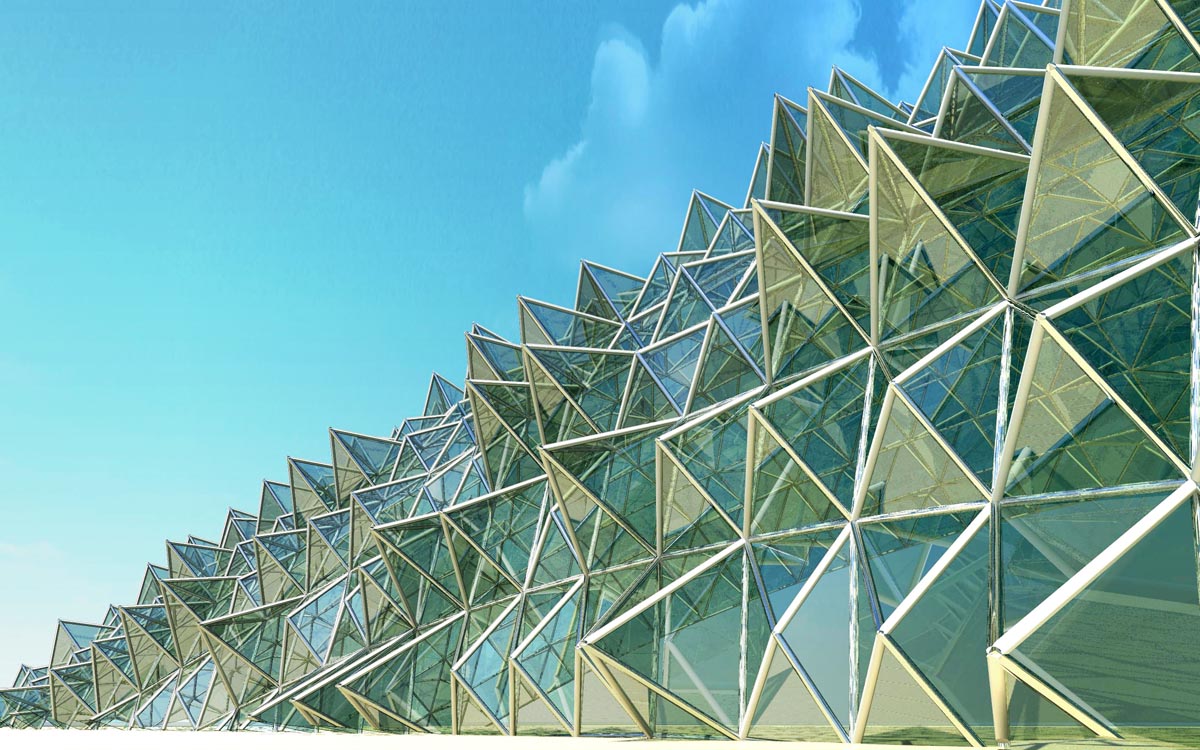
Screen, Mesh, Trellis, Latticework ... there are many words to choose from. Wikipedia gives at least 10 alternate spellings for Mashrabiya. And there are overlapping ideas involved: porosity, privacy, sun-filter, air-flow. Perhaps it's all about ambiguity.

Any architect who has worked in the Middle East has tried to reinvent the lattice at some point, find a fresh interpretation, out-brize-soleil le corbusier. So the question arises, "how to adapt the mashrabiya to an adaptive curtain panel".

Curtain panels by pattern are by definition adaptive. They fit themselves to the shape available. Actually even conventional curtain panel families do this, but only within the constraints of a planar rectangle. Panels by pattern have to adapt to all manner of distortions including twisting. The approach to creating geometry is therefore quite different.

Take a square grid. You can host points on the 4 ref lines that define the boundaries. Positioning these at 0.7 & 0.3 will approximate an octagon. Join Points in pairs. Spline by point. You can develop a simple mesh that bends and twists to fit curved surfaces.

Then play with the geometry, maybe introduce some curves by connecting 3 points.

Nothing very spectacular, but you have to start somewhere.


Any architect who has worked in the Middle East has tried to reinvent the lattice at some point, find a fresh interpretation, out-brize-soleil le corbusier. So the question arises, "how to adapt the mashrabiya to an adaptive curtain panel".

Curtain panels by pattern are by definition adaptive. They fit themselves to the shape available. Actually even conventional curtain panel families do this, but only within the constraints of a planar rectangle. Panels by pattern have to adapt to all manner of distortions including twisting. The approach to creating geometry is therefore quite different.

Take a square grid. You can host points on the 4 ref lines that define the boundaries. Positioning these at 0.7 & 0.3 will approximate an octagon. Join Points in pairs. Spline by point. You can develop a simple mesh that bends and twists to fit curved surfaces.

Then play with the geometry, maybe introduce some curves by connecting 3 points.

Nothing very spectacular, but you have to start somewhere.